How to Teach Kids to Pray, Step by Step
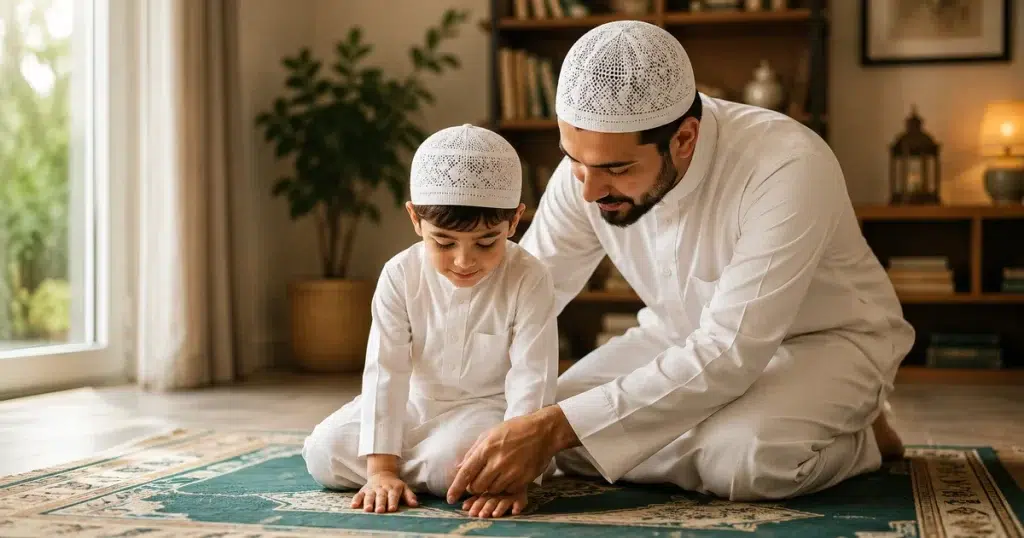
Table of Contents
- How to Teach Kids to Pray: Why Early, Gentle Teaching Matters So Much
- The Age-by-Age Roadmap
- Step 1 – Let Them Watch Before You Ask Them to Perform
- Step 2 – Teach Movements Before Words
- Step 3 – Introduce Short Surahs, One at a Time
- Step 4 – Put It All Together
- Step 5 – Consistency Beats Perfection, Always
- Common Mistakes Parents Make
- When One-on-One Teaching Makes the Biggest Difference
- Start Building This Habit Today
Want to teach kids to pray but not sure where to even start?
Does your child squirm the moment you mention prayer time, or copy your movements without knowing what any of it means yet?
Don’t worry — that’s completely normal.
Teaching a child to pray Salah isn’t about perfect recitation from day one — it’s about building a relationship with prayer they’ll carry for life.
The good news? With the right approach at the right age, learning Salah becomes something your child looks forward to, not resists.
How to Teach Kids to Pray: Why Early, Gentle Teaching Matters So Much

For Muslim families raising kids in Western countries, prayer often has to be taught entirely at home — without the daily community reinforcement kids in Muslim-majority countries absorb naturally. That makes how you introduce it even more important.
- A child’s first experience of prayer shapes how they feel about it for years afterward.
- Pressure and correction-only teaching often creates avoidance later on.
- Warmth and consistency build a lifelong habit far better than strictness alone.
- Kids learn best by watching first, then copying, then understanding.
💬 FAQ Insight: “What age should I actually start?”
Most scholars point to age 7 as when prayer becomes an expectation (based on the well-known hadith from Abu Dawud), but passive exposure — letting a child watch and loosely copy — can start as early as age 3. Either way, the goal when you teach kids to pray is gradual comfort, not instant mastery.
The Age-by-Age Roadmap
Trying to teach the full Salah all at once overwhelms most children. Breaking it into stages works far better.
| Age | Focus | What to Expect |
| 3–5 years | Watch & copy | Loose imitation, no pressure for accuracy |
| 5–6 years | Movements first | Standing, bowing, prostration — taught playfully |
| 6–7 years | Short surahs | Al-Fatiha, Al-Ikhlas, one verse at a time |
| 7+ years | Full prayer | Movements + recitation combined, consistency expected |
🌿 Once you see it broken into stages like this, teaching prayer stops feeling overwhelming — it becomes a simple, natural progression.
Step 1 – Let Them Watch Before You Ask Them to Perform
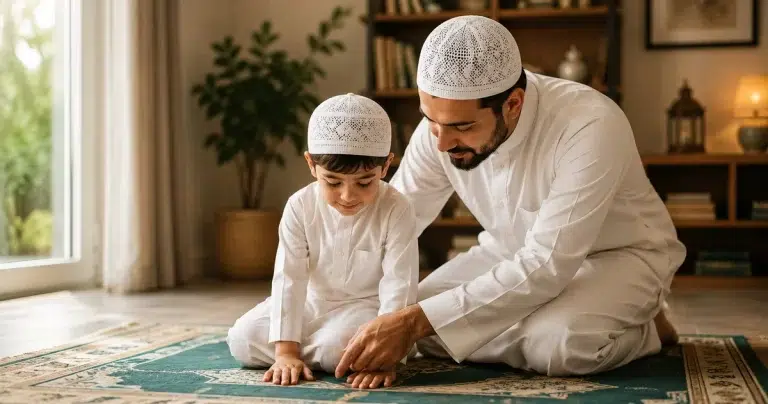
Before correcting anything, let your child simply be present. Standing or sitting beside you during your own prayer, without expectation, builds familiarity and comfort long before any formal teaching begins.
- Let them join loosely — no correction needed at this stage.
- Keep the mood calm and unhurried, never rushed.
- Let curiosity lead — answer questions simply if they ask.
Step 2 – Teach Movements Before Words
Children pick up physical sequences faster than memorized Arabic. Start with the positions — standing (Qiyam), bowing (Ruku), prostration (Sujood), sitting (Julus) — as a fun, repeatable activity outside of actual prayer time.
💬 FAQ Insight: “My child gets the movements right but says nothing — is that okay?”
Completely okay. Movement fluency almost always comes before recitation fluency — that’s the natural order, not a problem to fix.
Step 3 – Introduce Short Surahs, One at a Time
Start with Surah Al-Fatiha, then one or two short surahs — Al-Ikhlas, Al-Falaq, An-Nas are common first choices. One properly memorized surah is worth more than five half-memorized ones.
- Repeat daily in short, 5–10 minute bursts.
- Recite together before asking your child to recite alone.
- Celebrate small wins loudly — motivation compounds.
🌿 AyulQuran’s Basics of Islam for Kids course is built around exactly this pacing — short, encouraging sessions designed for how young children actually learn.
Step 4 – Put It All Together
Once movements and short surahs feel natural separately, combine them into a full, simple two-Rakah Salah. This is also the age (7+) most scholars point to for making prayer a genuine, gentle expectation rather than just an invitation.
🌿 If your child is also starting to read Arabic script alongside memorizing surahs, our Quran Reading Basics course pairs well with this stage.
Step 5 – Consistency Beats Perfection, Always

A child who prays imperfectly every day becomes a confident adult who prays well. A child pressured for perfection early often becomes an adult who avoids praying altogether.
💡 Pro Tip: Say “almost — try again” instead of “no, that’s wrong.” The same correction lands completely differently to a child.
💬 Chat with us on WhatsApp now!
Common Mistakes Parents Make
Even well-meaning parents can accidentally make it harder to teach kids to pray than it needs to be. Here’s what to watch for:
- Teaching everything at once instead of stage by stage.
- Correcting in a way that feels like criticism rather than encouragement.
- Only praying “at” them, instead of visibly praying “with” them regularly.
- Skipping the “why” — even a simple explanation gives a child something to hold onto.
💬 FAQ Insight: “What if my child refuses or resists prayer time?”
Stay calm and consistent rather than forceful. Resistance is often about the moment, not the practice itself — gently returning to it the next day, without turning it into a battle, works far better long-term.
When One-on-One Teaching Makes the Biggest Difference
Many parents teach beautifully at home. Others find that a dedicated tutor — giving a child focused, one-on-one attention without competing against siblings or daily distractions — makes the whole process noticeably smoother and faster.
| Setting | Best For |
| Teaching at home | Building daily familiarity and comfort |
| One-on-one tutor | Focused correction, pacing, and structured progress |
🌿 Our tutors are Al-Azhar certified and experienced specifically with young learners — adjusting pace, tone, and session length to match your child, not a fixed curriculum.
Start Building This Habit Today

Learning to teach kids to pray isn’t about getting every word perfect from day one — it’s about building a relationship with prayer they’ll want to keep for life.
- Start with watching and copying — no pressure needed.
- Teach movements before words, and words in small pieces.
- Celebrate consistency over perfection, every time.
- Get a free trial lesson to see how guided, one-on-one teaching can help.
✨ Start today — book a free trial with AyulQuran and give your child a joyful first relationship with prayer.
💬 Chat with us on WhatsApp now!